Blog
Missy Elliott: Those Who Saw Her Will Never Forget
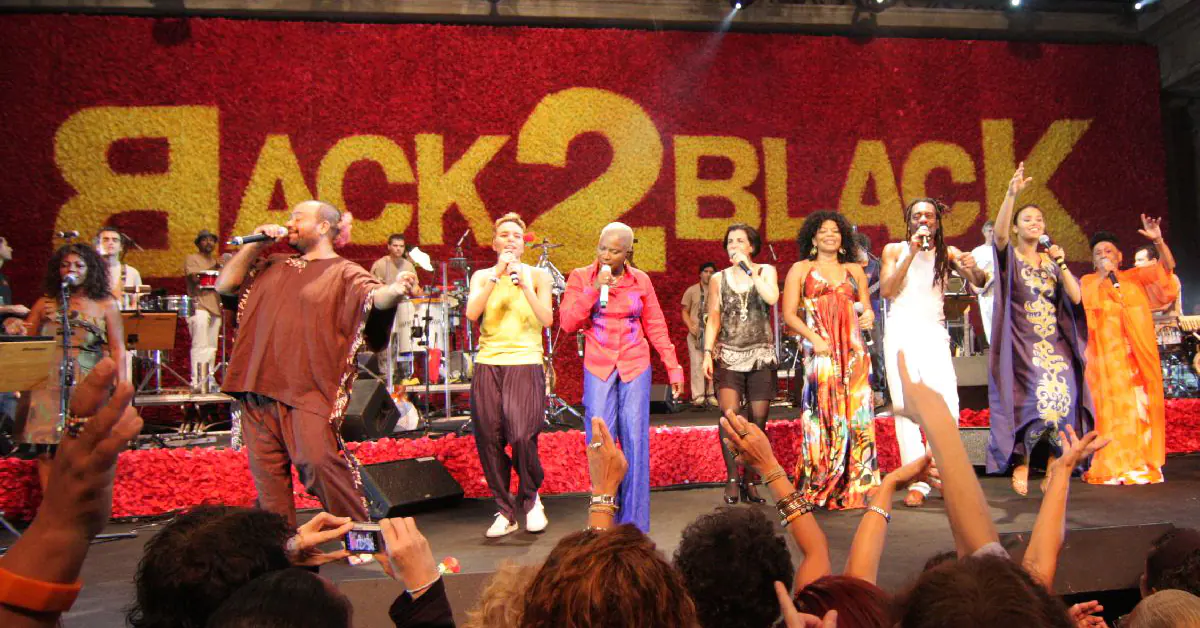
Missy Elliott at Back2Black delivered a historic performance that left a lasting mark on the festival and on global Black music culture.
- Back2Black
- Music

One of the greatest names in global rap, winner of five Grammy Awards, performed just once in Brazil.
HERMANO VIANNA COLUMN IN O GLOBO, NOVEMBER 22, 2012
Loud Girls
Missy Elliott may not fit the “bombshell” stereotype, but she is one of the most influential artists in the history of hip-hop.
Missy Elliott, who performs tomorrow at the Back2Black Festival, is the most important female name in the history of hip-hop. I may be committing an injustice with such a statement, but I believe that even those who might feel overlooked would share my admiration for everything Missy has done — and continues to do — for the evolution of contemporary Black music. Yes, because her influence is not limited to rap. Think of any of today’s mega-popular singers (Beyoncé, Rihanna, and others). In all their hits, we hear attempts to master a (post-electronic) vocal territory that Missy pioneered or outright created.
Do not expect to see on stage a hyper-sexualized pop figure in ripped shorts and a bare midriff — a sex symbol in times dominated by a cynical pop aesthetic that seems determined to drag the world downhill. Missy does not cultivate an image designed for YouTube virality. But that has never been a commercial problem: she has sold millions of records as a solo artist and, even when she was considered “outside standard measurements,” she launched a clothing line with Adidas.
I enjoy her albums (which include some of the greatest dancefloor tracks of all time), but I am even more interested in her groundbreaking work as a composer, arranger, and producer, as well as in her philosophy of sonic construction and deconstruction.
Her career is a radical example of what John Cage described as a “composer (organizer of sounds).” Just because she operates within the realm of popular song — meant for radio airplay and to make crowds dance — does not mean she cannot be considered avant-garde, perhaps even more so than what is traditionally labeled as such.
Missy emerged from a musical scene that developed in the high schools of Virginia Beach, a seaside town with little prominence in American artistic culture (Ella Fitzgerald being a notable exception). Her teenage circle included other brilliant sound organizers such as Timbaland, members of The Neptunes, and Clipse.
I still remember the shock of first encountering the post-hip-hop creations from Virginia Beach — more specifically, a Timbaland/Missy production-composition partnership that would go on to release a series of powerful hits. I was in Mozambique at the time, filming the television series Além-Mar.
The local driver played several CDs inside the van. Nothing particularly caught my attention at first — he favored competent but generic soul music. Then a love song came on, driven by a very strange beat. My mind bent. I couldn’t identify what I was hearing: it felt like a soul/drum’n’bass hybrid, but with an entirely new groove.
And the voice kept singing with an angelic melody, as if the rhythmic revolution underneath it were completely ordinary. The contrast was more than perfect. I asked to see the album cover: One in a Million, by Aaliyah. Composed by Timbaland and Missy. I wrote down their names and began following every move of their careers.
A hallmark of Missy’s sonic thinking is her use of vocal polyphony, heavily fragmented by cutting-edge digital recording technologies, enabling increasingly baroque “cut and paste” strategies. There is a symbiosis between these recording methods and Missy’s mind, which seems to compose already in a Dadaist collage.
And the miracle is that this results in catchiness rather than alienation (nothing against alienation — as regular readers of this column know well, I can’t imagine the best parts of our lives without irresistibly sticky hits). Missy offers us a masterclass for increasingly modern times: how to be radical and challenging without ever losing pop tenderness and accessibility. An unsolvable contradiction? Listen to One in a Million — it is sublime, tender radicalism.
This year’s Back2Black lineup is especially stimulating in terms of female artists: Gal Costa (there is certainly some Missy in Recanto), Santigold, Ms. Lauryn Hill, Fatoumata Diawara (I need to write a column about Mali), Nneka, Daúde, Dona Onete. But there are also Martinho da Vila, Siba, Emicida, and Naná Vasconcelos (shall we start preparing to celebrate the 40th anniversary of the album Amazonas?).
Categories
Recent Posts
- Categories: Music
- Back2Black